
EVENT DOCUMENTATION REPORT
FESTIVAL AT A GLANCE
Venue (Physical): International Conference Centre, University of Ibadan
Virtual Sessions: Day One of the Festival
Physical Day: Day Two of the Festival
Virtual Panels: Nine sessions across Day One
Total Attendance Across Both Days: Over 2,000 participants, including delegations from secondary schools across Ibadan.
FEATURE QUOTES
“Ibadan will never sink.”
– Prof Remi Raji-Oyelade
“Without art, there is no technology.”
– Ms. Opeyemi Ojo, Permanent Secretary, Oyo State Ministry of Education, representing Hon. Olusegun Olayiwola, Commissioner for Education, Science and Technology, Oyo State
“Technology must serve humanity, not replace it.”
– Professor Dan Izevbaye
INTRODUCTION
The 2025 Ibadan Book and Art Festival (IbaFest) is the inaugural edition of a festival conceived to gather relevant stakeholders in the education and creative sectors, and to present Ibadan as the creative capital of Nigeria. The festival was built around the theme “The Past as Prologue to the Future,” a theme that ran through virtually every session of the two-day event, from the historical excavation of the Mbari movement to the discussion of Artificial Intelligence in the keynote address.
The festival held across two formats: a full day of virtual panel sessions on Day One, and a physical programme on Day Two at the International Conference Centre, University of Ibadan (UI). Together, the two days brought together writers, scholars, filmmakers, students, government representatives, and cultural advocates from across Nigeria and the diaspora. Day One comprised nine virtual panel sessions and a poetry interlude, while Day Two opened with a dedicated engagement session for secondary school students before moving into keynote and goodwill addresses, a poetry performance, and three afternoon panel discussions, closing with a session spotlighting Nigeria’s emerging writers.
This report documents both days in full. It covers all nine virtual panel sessions from Day One, the poetry interlude, and the complete physical programme from Day Two, including the student engagement session, the welcome address, the keynote address, the goodwill messages, the panel discussions, and the poetry performance. Where sessions covered connected themes, those connections are noted within the body of the report.
DAY ONE: VIRTUAL SESSIONS
The virtual programme opened at 10:03 am with Kayode Sanni as host, starting with 18 participants. By the close of the final panel at 5:58 pm, the programme had moved through nine sessions covering literature, film, memory, identity, exile, and the creative future of Ibadan.
Panel Session One: Literary Ibadan: Mbari, the Arts, and the Spirit of Cultural Continuity
Moderator:
Ndubuisi Martins Aniemeka
Panellists:
Dr Akin Tella, Dr Funmi Gaji
The moderator, Ndubuisi Martins, opened the panel by noting that Ibadan has produced significant literary and cultural icons, and that for many years graduates have regarded the University of Ibadan as an institution that validates their certificates. Dr Akin Tella, who teaches Discourse Analysis and Pragmatics at UI, then traced the origins of the Mbari cultural movement to 1961, when visual artists, writers, a German publisher and collector, and other African cultural figures gathered in Ibadan with a shared creative purpose. He referred to Prof Femi Osofisan’s lecture The City as Muse: Ibadan and the Efflorescence of Nigerian Literature, delivered as part of the University of Ibadan’s lecture series, which illuminates the city’s enduring role in shaping literary creativity. He noted that Chinua Achebe played a significant role in naming the movement, and that the original Mbari space on Onireke Road included a library alongside its creative facilities. In time, a sister space, Mbari Mbayo, was established in Osogbo.
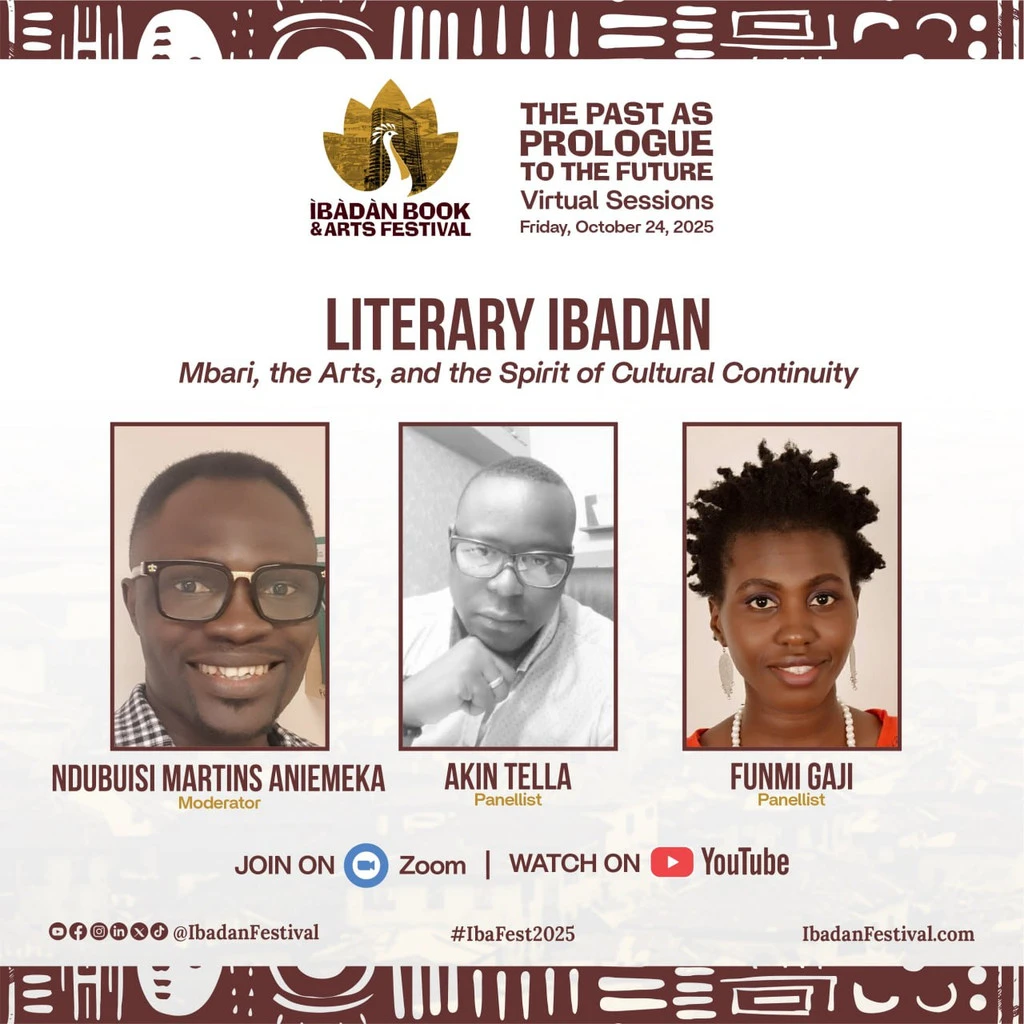
Dr Funmi Gaji, Founder and Editor-in-Chief of ArtisansQuill, approached Mbari from the perspective of cultural convergence, noting its roots in Igbo tradition as an act of honouring Ala, the earth goddess. She described art as therapeutic, capable of appeasing the gods while mending the heart of the community, and described the construction of Mbari huts as a reflection of the cycle of creation, destruction, and absorption. She argued that art sits at the beginning of possibilities and solutions, and referred to Prof Toyin Falola’s observation that we now find ourselves in “an intellectual war.” Both panellists agreed that future creatives need not replicate Mbari by name, but should build platforms where genuine creative conversation and action can take root. They urged the audience to continue the conversation beyond the festival, as an offering towards mending a broken world. The session grew to 40 participants by its close.
Panel Session Two: The Challenges and Opportunities of Short Films and Documentary Making in Nigeria
Moderator:
Kingsley Alumona
Panellists:
Ifeoluwa Olutayo, Philip Fagbeyiro, Ebimoboere Ibinabo Dan-Asisah
The second panel brought documentary filmmakers together to discuss the practical realities of short film production in Nigeria. Ebimoboere Ibinabo Dan-Asisah opened the conversation with reflections on the representation of women in the film industry, and on the challenges she faced as a first-time documentary filmmaker. She explained that her objective was to focus on women, girls and the female body, and that she wanted her scripts to be relatable to women, which led her to speak with people who understood the lived realities of Nigerian women. She described writing her first draft, circulating it for review and recommendations, and confronting the problem of distribution after production, noting what she described as gatekeeping in the industry.
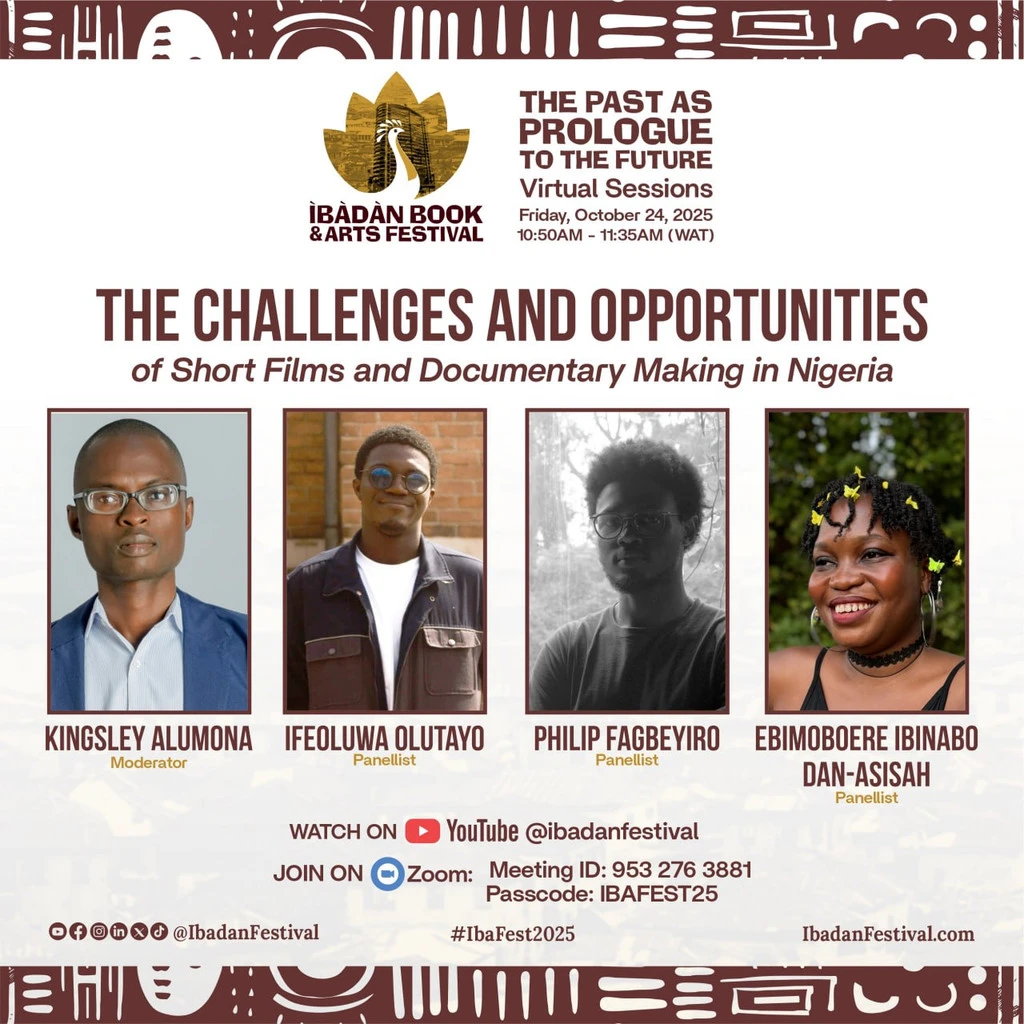
Philip Fagbeyiro, who has a background in Architecture, described how his documentary work on early cinemas and open spaces in Lagos required him to consult historians and community knowledge-holders across Lagos Island, Ikorodu, and Badagry. One of his chief production challenges, he said, was finding suitable resource persons to interview. He noted that his academic training continues to shape how he approaches film.
Ifeoluwa Olutayo, reflecting on the trio’s shared Memory Post Archival Project, said that expectations are not always the reality. He explained that securing archival footage and older materials was a considerable challenge, compounded by the ordinary difficulty of holding people to deadlines. He noted specifically that relatively few primary materials documenting eighteenth and nineteenth-century life in Lagos and West Africa exist in the public domain, which complicated the research. He added that awards can never accurately measure the quality of a film. The panel closed with about 37 participants in attendance.
Poetry Interlude: Readings by Nurain Oladeji and Sodiq Alabi
Between the second and third panels, an audience of 11 listeners heard poetry readings from two Nigerian poets. Nurain Oladeji, a graduate Master of Fine Arts (MFA) student of poetry at Virginia Tech, read from his chapbook Home is a Heart That Flees, published by the African Poetry Book Fund and Akashic Books. Sodiq Alabi read from his collection Dead Birds and Frozen Frames. The readings provided a measured and contemplative interval between the day’s more discursive sessions.
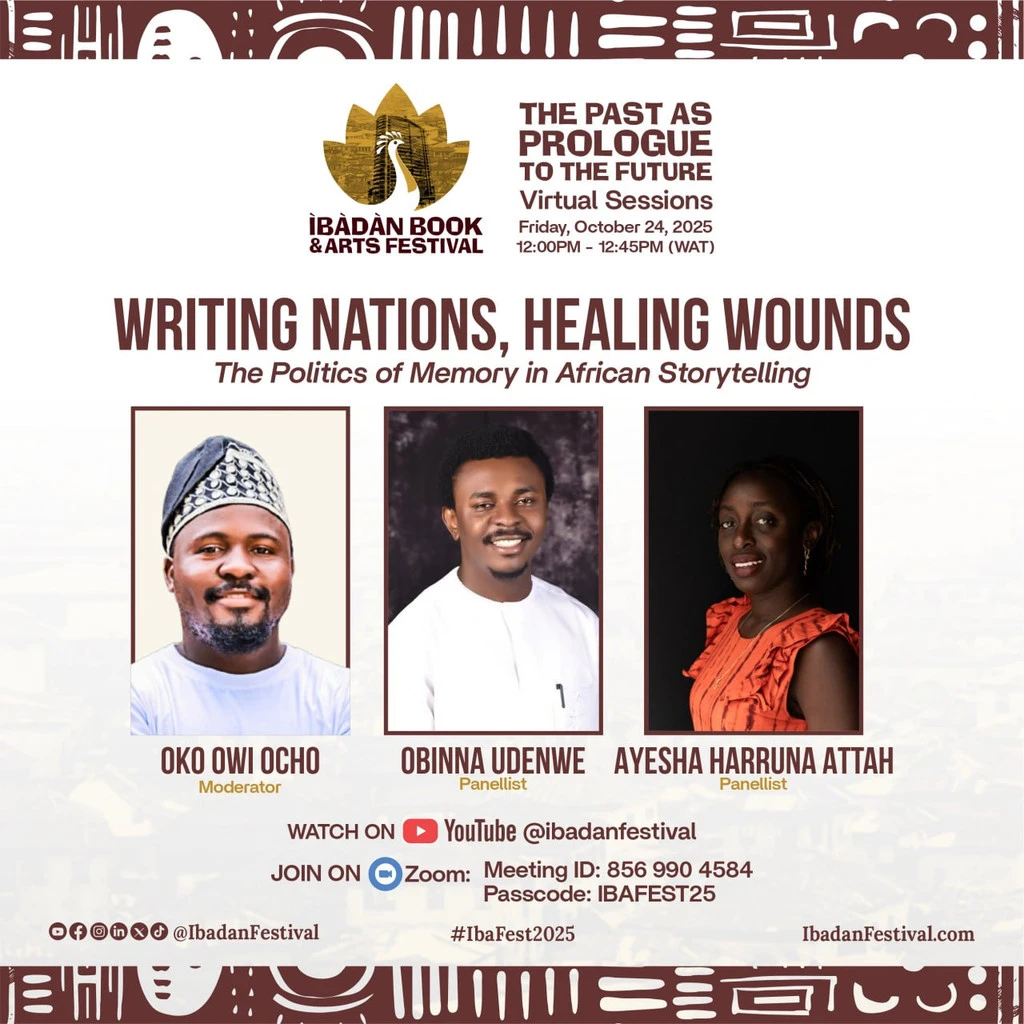
Panel Session Three: Writing Nations, Healing Wounds: The Politics of Memory in African Storytelling
Moderator:
Oko Owi Ocho
Panellists:
Obinna Udenwe, Ayesha Haruna Attah (author of The Hundred Wells of Salaga and The Deep Blue Between)
This session offered a wide-ranging exploration of memory, spirituality, and literary heritage across West Africa. Moderator Oko Owi Ocho, who introduced himself as a happy moderator, opened the conversation with Ghanaian novelist Ayesha Haruna Attah by asking about the influence of Pan-Africanism on her work. Ayesha cited her formative relationship with Ayi Kwei Armah, whom she described as holding the same place in Ghanaian literary consciousness that Chinua Achebe holds for Nigerians. She was his student at the age of 23, and his perspective as a writer who engaged with pre-colonial Ghana shaped her understanding of storytelling and history.
The conversation moved to Nigerian novelist Obinna Udenwe, whose novel Years of Shame informed a discussion of African spirituality in the postmodern world. Obinna argued that cosmological practices are unavoidable for Africans regardless of personal belief, and used the character of Patrick in his novel as an example of someone who believed himself immune to the consequences of a communal oath, only to discover otherwise. He also noted that his 2014 novel Satans and Shaitans had earlier drawn public attention to terrorism in Nigeria, arguing that literary works change things at both the societal and personal level. The moderator, in agreement, referenced the enduring spirituality depicted in Okey Ndibe’s Foreign Gods, Inc.
The moderator raised W. H. Auden’s proposition that poetry makes nothing happen. Obinna pushed back directly, citing his own novel’s contribution to bringing the role of Abakaliki people in the Nigerian Civil War to wider attention. Ayesha agreed and compared African spiritual systems to tailored garments, as opposed to the ill-fitting nature of imported religions. She pointed to environmental degradation in Ghana, specifically bodies of water turning brown from illegal mining, or galamsey, as evidence of what is lost when sacred natural spaces lose their protection through spiritual traditions.
Ayesha then offered a detailed account of Ghanaian literary history, dividing writers into four broad groupings: pre-colonial Christian writers such as Theophilus Opoku, whose records of northern Ghana informed her historical novel The Hundred Wells of Salaga; independence-era writers including Kwame Nkrumah, Ayi Kwei Armah, and her father, Alhaji Abdul Rahman Harruna Attah; the 1990s writers, who produced what she described as insular writing primarily addressing Ghanaian concerns, including Ama Ata Aidoo; and the Afropolitan writers of the early 2010s, a category she finds questionable but useful, under which she places writers such as Taiye Selasi, Yaa Gyasi, and Peace Adzo Medie, alongside herself.
The discussion also addressed questions of ethnic identity within national and continental literary identities, with Obinna noting the difficulty of works being read outside their specific cultural context, even when those works address concerns of broad national relevance. Audience member Igbekele Salawu drew attention to Kobina Sekyi’s The Blinkards as a depiction of Ghanaians navigating modernity, which the moderator welcomed as an example of the kind of cross-continental literary conversation the session encouraged.
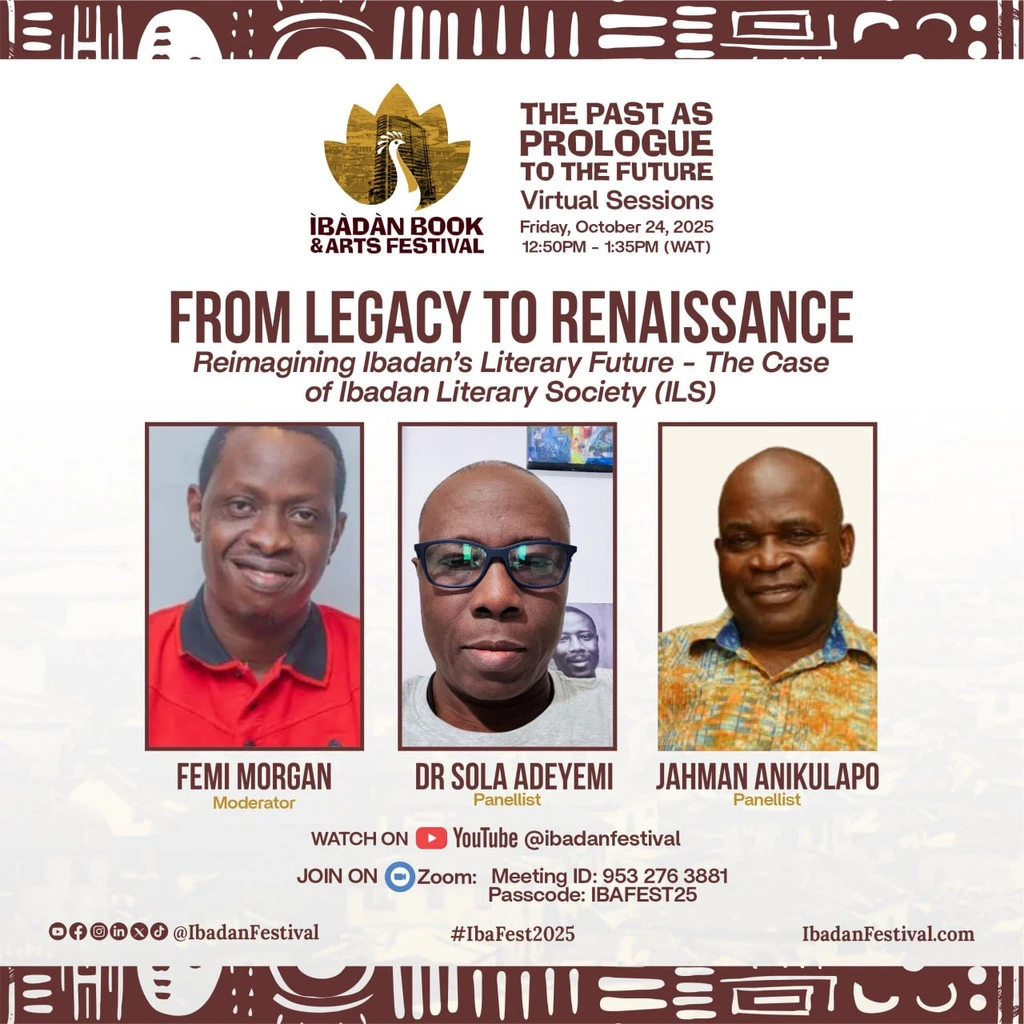
Panel Session Four: From Legacy to Renaissance: Reimagining Ibadan’s Literary Future, The Case of the Ibadan Literary Society
Moderator:
Femi Morgan
Panellists:
Dr. Sola Adeyemi, Jahman Anikulapo
Femi Morgan introduced the panellists by referencing their roles in the Committee for Relevant Art (CORA). Jahman Anikulapo, a former editor at the Guardian newspaper and director of the Lagos Book and Art Festival, which he has run for 27 years, spoke to his larger ambition of seeing a book and art festival in every Nigerian city. He traced the origins of that idea to Femi Odugbemi’s film Ibadan, the Cradle Nigerian Literati, created when playwright Femi Osofisan was approaching his 70th birthday.
Dr. Sola Adeyemi, Professor of Drama at the University of East Anglia and Board Chair of the African Theatre Association, presented a visual account of Ibadan titled Ibadan: The Cradle of Literature. He noted that Ibadan, settled in 1829, became within decades a centre for publishing, education, and cultural production. It hosted the first university in West Africa and has produced more writers than any comparable Nigerian city. He spoke about the Ibadan Literary Society’s (ILS) objectives, which include archiving all writers associated with the city and creating a centre with galleries and research facilities for literary development.
The moderator raised the demolition of the Mbari House in Mokola as a failure of cultural foresight. Dr. Sola acknowledged the loss and attributed it partly to the collapse of the Mbari movement’s funding base, which had included, he said, a company secretly funded by the United States Central Intelligence Agency (CIA). The Civil War further fractured the community, scattering members including Wole Soyinka to Ife and J. P. Clark to Lagos. Kola Tubosun is currently working to compile all available Mbari journals. Dr. Sola concluded that what is needed now is a collective voice with a clear objective of making Ibadan renowned for its arts and culture, without regard to tribe or nationality.
Jahman shared a personal memory of riding in a car with Wole Soyinka during preparations for a production of The Man Died, where a scene was shot in a new building modelled on the former Mbari House. He spoke of the nostalgia that fuelled projects like the Ibadan Poetry League. Dr. Sola, for his part, described Ibadan as always home in his imagination, recounting his formative years at Wesley College and the Arts Theatre, and quoting the poet Lekan Are: “If you want to get rid of Ibadan, get rid of me.”
Panel Session Five: Poetry as Voice for the Silenced, Disappeared and Displaced
Moderator:
Praise Osawaru
Panellists:
Othuke Umukoro, Hussein Ahmed
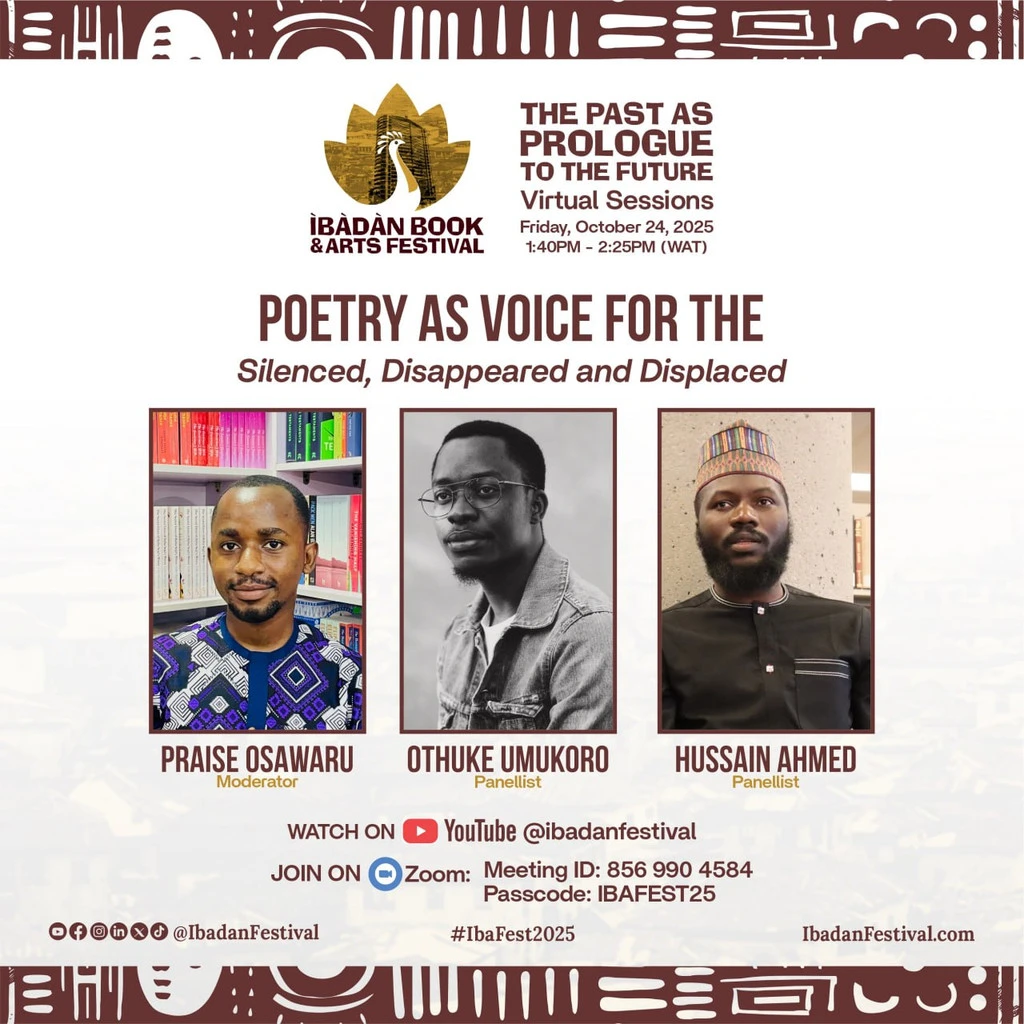
The moderator opened the session by inviting both panellists to read from their collections. The discussion that followed examined poetry as an act of remembrance and resistance, asking how poets bear witness to loss and injustice and give voice to those erased by history. Hussein Ahmed argued that displacement extends beyond the geographical, encompassing the self, the spiritual, and the emotional; any experience of change, he said, is a form of displacement. Othuke Umukoro described poetry as the oldest genre, one in which wisdom is stored, and stated plainly that it is the responsibility of poets to preserve memory. “Whatever you write about,” he said, “you are preserving it.”
Panel Session Six: Geography of Belonging: Finding Home in a Place of Exile
Moderator:
S. Su’eddie Vershima Agema
Panellists:
Victoria Princewill, Amaka Azie
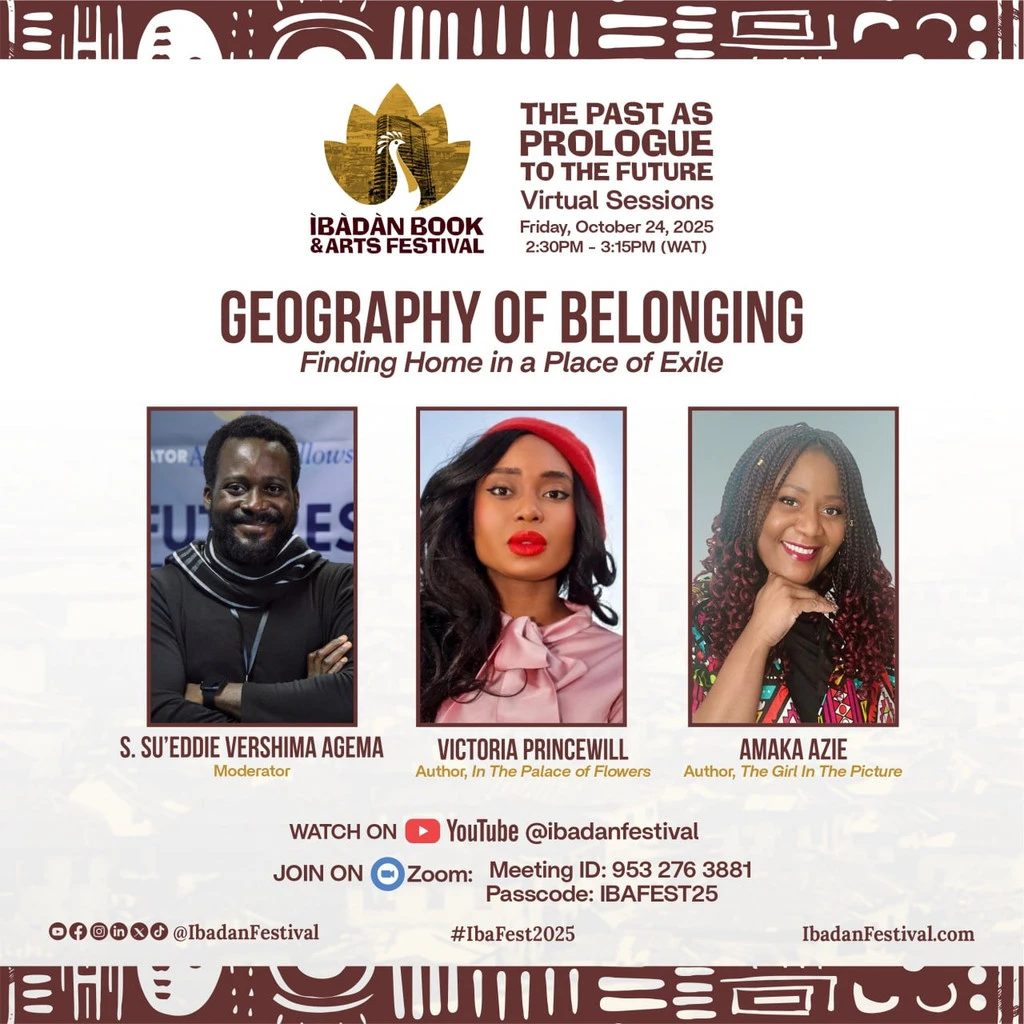
This session explored what home and belonging mean for writers living across cultures. Amaka Azie, a Nigerian writer based in the United Kingdom (UK), opened with the statement that home is not just a location; it is a place where she is loved for being herself. She described how humour and family life, including the particular exaggerations of Nigerian parents, shapes her writing. Victoria Princewill drew on her own book to give voice to the silenced and displaced. The moderator closed the session with a rapid-fire round of questions, asking the panellists what smells reminded them of Nigeria and which English foods confused them most, which brought a welcome lightness to the conversation.
Panel Session Seven: The City as Muse: How Urban Spaces Inspire Creativity and Preserve Cultural Memory
Moderator:
Ifesinachi Nwadike
Panelists:
Rasaq Malik Gbolahan, Chinua Ezenwa-Ohaeto, Carl Terver
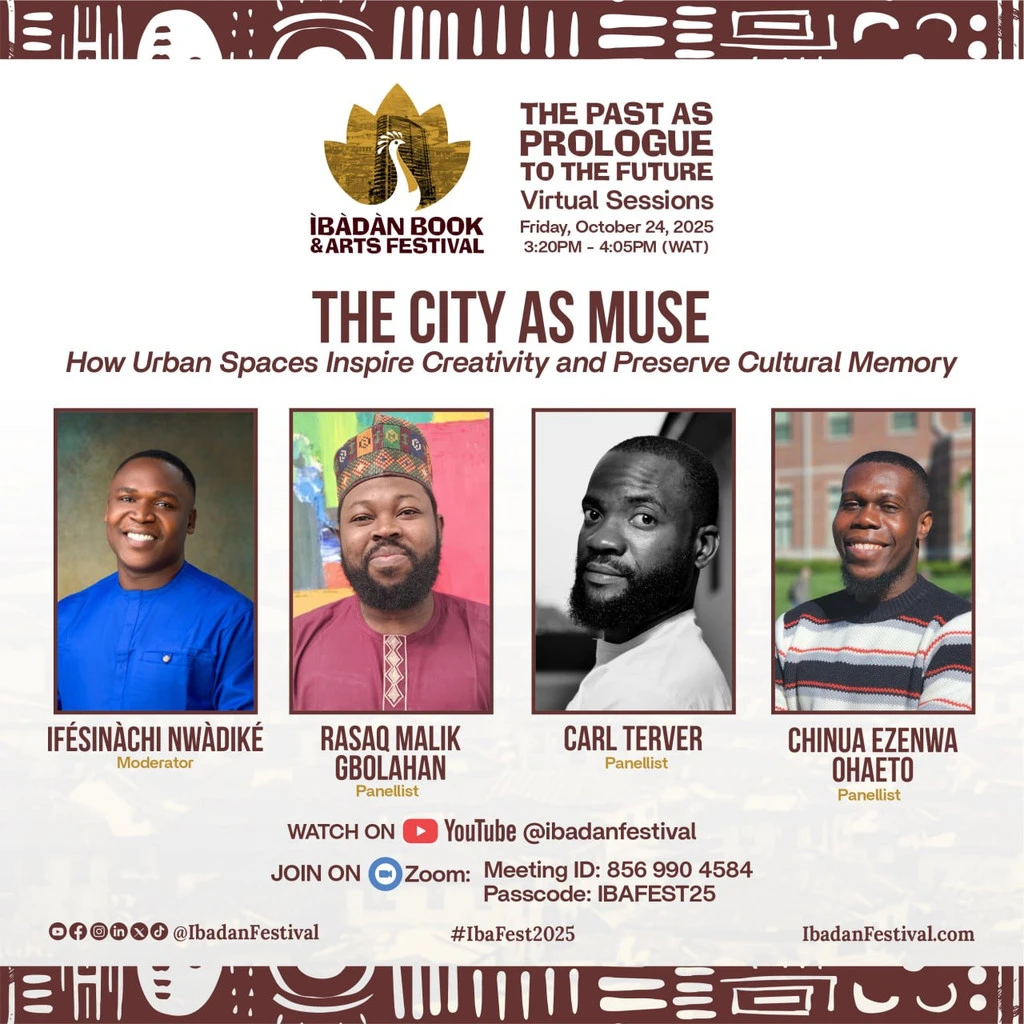
Three writers discussed how urban spaces shape artistic imagination and serve as living archives of cultural memory. Rasaq Malik Gbolahan spoke about how Ibadan has shaped his sense of home and creative identity as a poet, and noted that Agbowo Magazine also has its roots at the University of Ibadan. Chinua Ezenwa-Ohaeto added that the language of the city, its rhythms and registers, feeds directly into poetry. Carl Terver described cities as dynamic witnesses to the creative act, arguing that the city is never merely a setting but always a participant in the writer’s work.
Panel Session Eight: The Ruins and the Promise: Postcolonial Dreams and the Reality of Ordinary Lives
Moderator:
S. Su’eddie Vershima Agema
Panellists:
Prof. Akin Adesokan, Dr. Olumide Olutola
This panel addressed the distance between the promises of postcolonial independence and the realities of ordinary Nigerian life. The moderator asked both panellists what came to mind at the word ruin. Professor Akin Adesokan said that in ruin, there is architecture, meaning that something positive can grow from what has fallen. Dr. Olumide Olutola said, simply, devastation. On the word promise, Dr. Olumide described it as a symbol of commitment and hope for a new beginning. Professor Akin said promises represent the possibilities of failure, because they are better made than kept.
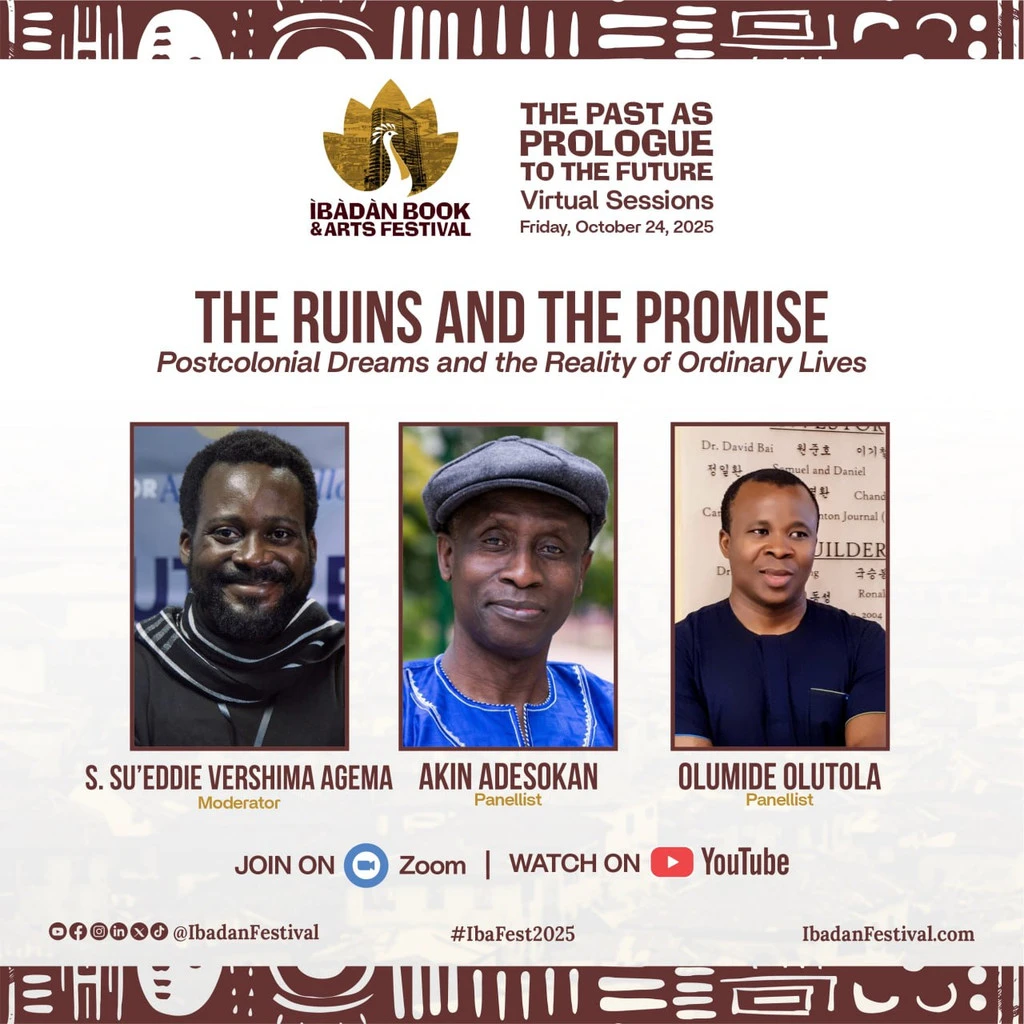
Asked whether Nigeria has more ruin than promise, Professor Akin described the country as a work in progress, and attributed many of its difficulties to an exploitative class and to external impositions that do not respect ordinary people. Both panellists closed by sharing what gives them hope. Professor Akin said that even in the darkest times, hope exists. Dr. Olumide said Nigeria is not dead, and therefore there is hope.
Panel Session Nine: Between Scar and Song: Writing Trauma, Migration, and Memory
Moderator:
Olaitan Junaid
Panellists:
Olajide Salawu, Adedayo Agarau
Session End Time:
5:58 pm
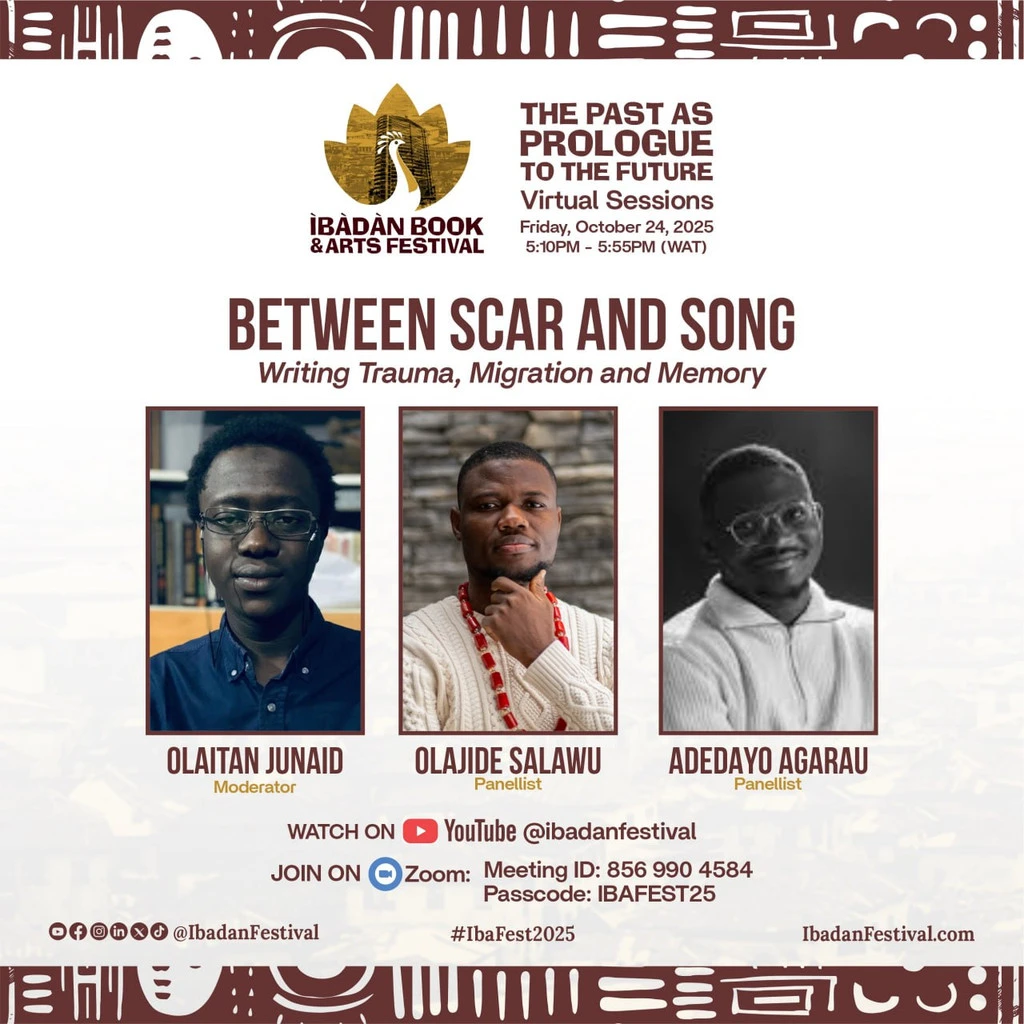
The final virtual session of Day One examined how writers transform trauma and migration into stories of survival. The panellists discussed how memory shapes identity and how the act of writing functions simultaneously as healing and resistance. They explored the balance between pain and beauty, between scar and song, and the ways literature gives form to loss and displacement. The session closed the virtual day at 5:58 pm.
DAY TWO: PHYSICAL PROGRAMME
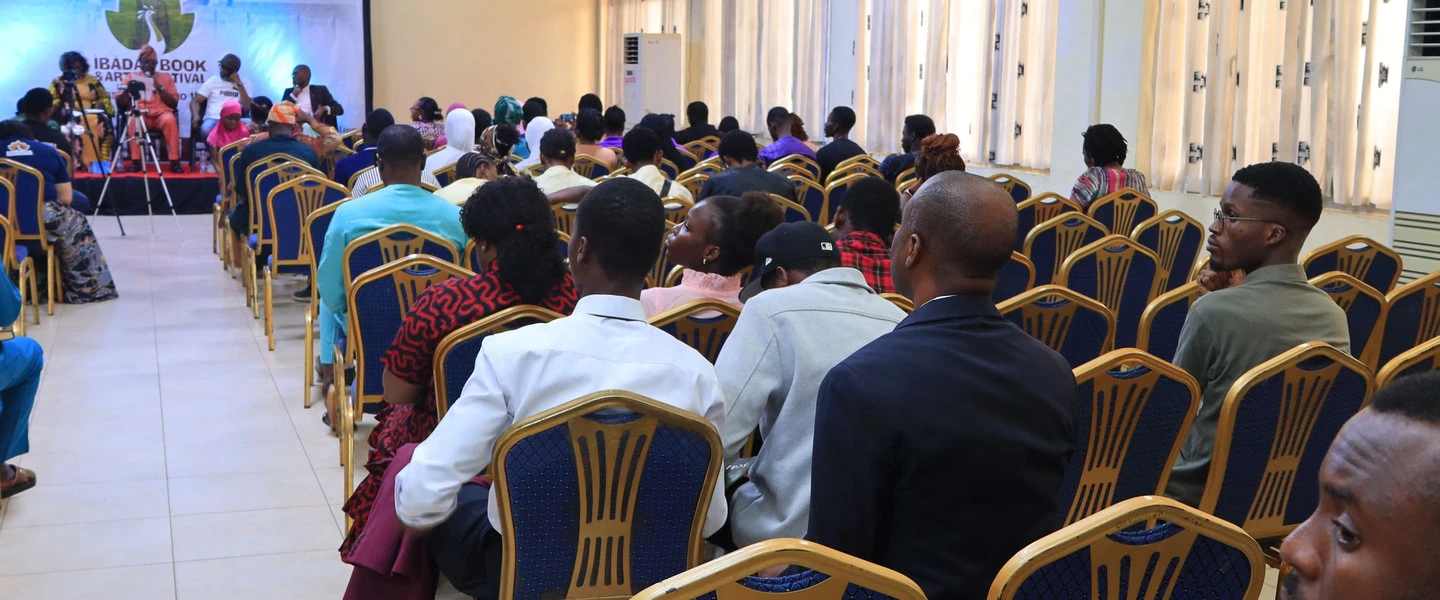
The physical day of the festival was held at the International Conference Centre, University of Ibadan, and drew over 300 participants. Secondary school students formed a significant part of the audience. According to the festival’s attendance register, delegations attended from nine secondary schools: The Lord’s Field High School, Good Success Educare Model College, Leaders Foundation, Oluyole Private Comprehensive College, Yinbol College, Great Minds Montessori School, Homydaze Academy, Mountainview School, and Kingsley Spring College. A full breakdown of registered student attendance by school appears at the end of this report. The day moved from a student engagement session in the morning through keynote and goodwill addresses, a poetry performance, and three afternoon panel discussions.
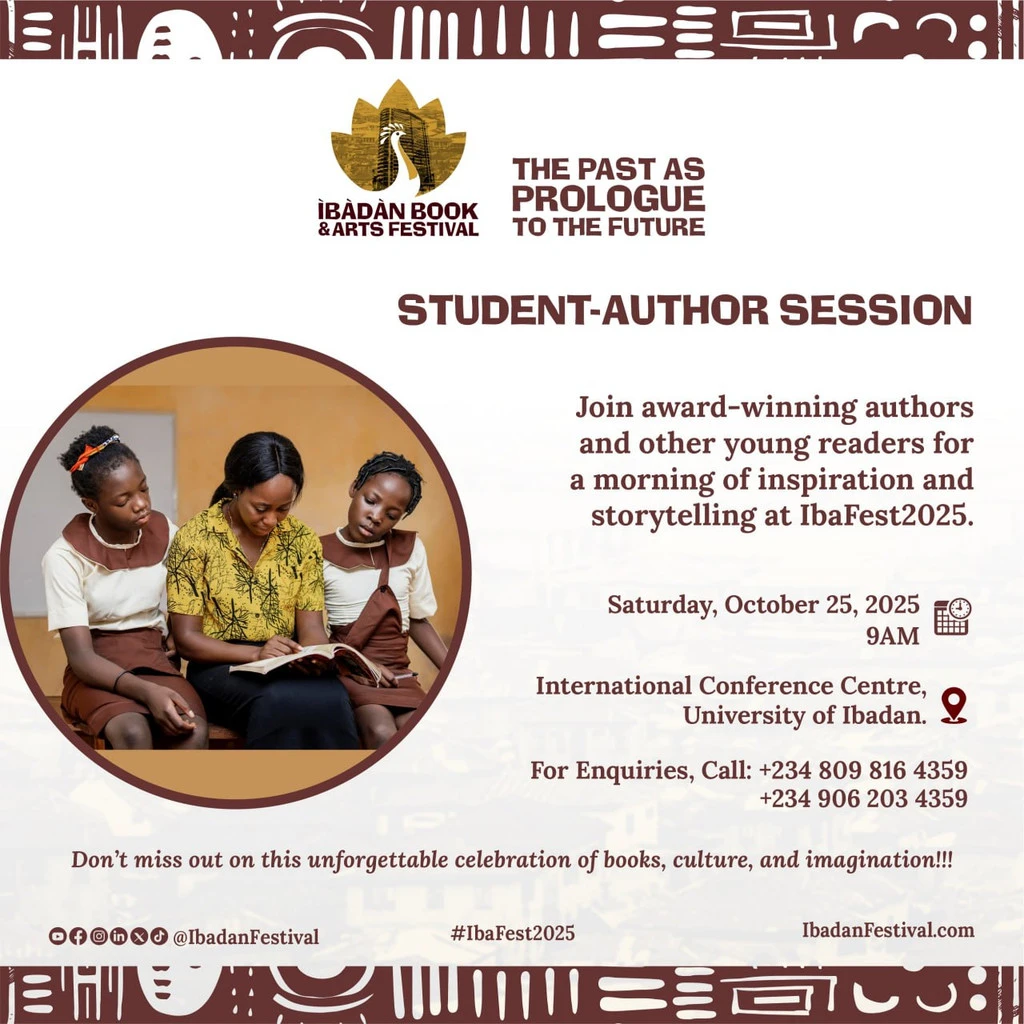
Morning Session: Reading and Interaction with Secondary School Students
Facilitator:
Mr. Kayode Sanni
Panellists:
Ayo Oyeku (author of The Magic Jalabiya), Prof Hyginus Ekwuazi (author of The Third Side of a Coin), Chiazor Ndidi-Enenmor (author of See Morocco, See Spain), Servio Gbadamosi
Duration:
10:22 am to 12:28 pm
The session began at 10:22 am with Mr Kayode Sanni welcoming students and teachers from various secondary schools to the festival. He introduced the panellists and encouraged the students to listen actively and to engage the panellists afterwards. The panel aimed to inspire young readers and to help them develop or deepen their love for books, storytelling, arts, and culture.
Ayo Oyeku, whose last two published titles were longlisted consecutively for the Nigeria Prize for Literature (NPL), described how his father encouraged him to write weekly essays on different topics as a child. His early exposure to books made him passionate about storytelling, leading to his first publishing deal at 17. “Whatever you attend to, you become,” he told the students, encouraging them to surround themselves with readers and writers.
Servio Gbadamosi, an award-winning poet and publisher and author of the poetry collection Where the Light Enters You, shared that his love for literature began at home, where his mother’s bookshelf became his early companion. He also credited his secondary school Literature teacher for nurturing his writing talent, and explained that reading widely helped him discover new ideas and deepen his creativity.
Chiazor Ndidi-Enenmor, a multi-talented author whose books have been longlisted or shortlisted for awards, said she began writing to raise awareness of children’s health, particularly malaria, and of wider social issues. She explained that stories can be powerful tools for learning, and addresses bullying and its emotional consequences, so as to help young readers understand its impact.
Prof. Hyginus Ekwuazi, a film and media scholar with literary awards to his credit, reminded the students that passion alone is not enough, and that a writer must understand their audience and create stories that “touch people’s lives.” Using George Orwell’s Animal Farm as an example, he showed how a simple story can carry deep truths about human behaviour and provoke lasting thought.
In response to the moderator’s question on the impact of social media on the reading culture of young adults, the panellists agreed that it has become a modern distraction, making it harder for young people to read. Chiazor advised parents and teachers to cultivate reading habits at home and in schools by creating book clubs and libraries, and encouraged students to buy books for their friends as gifts. Ayo Oyeku shared a symbolic story about a boy and an apple tree, explaining that while life brings distractions, people often return to books because they provide true guidance: “Books shape our decisions and give us answers that social media cannot.” Prof. Ekwuazi added that writers should adapt to the digital age by exploring new, internet-friendly writing styles to keep readers engaged.
Students then asked questions on reading and the literary space. The first enquired how a child can build the discipline and focus needed to mature as a reader; Prof. Ekwuazi advised parents to guide children by discovering what interests them and providing suitable books, adding that young people can begin by reading even material that does not immediately interest them, until they find what does. The second question concerned managing distractions beyond technology; Chiazor responded by referring to her book A Father’s Pride, which addresses child abuse, and urged students to speak up and look out for their friends, while Ayo Oyeku added that children often imitate their parents’ behaviour, so adults should model good reading habits. A third student asked whether loving to write is a necessary consequence of loving to read; Chiazor explained that reading and writing are connected but not the same, and that one can enjoy reading without wanting to write. Another question concerned how to become a good writer; Ayo Oyeku replied, “Tiny drops make an ocean,” encouraging consistency and daily practice. A final question, on how science students might cultivate a reading habit, drew Ayo Oyeku’s advice that reading is essential for everyone, and that students should start with what they love and gradually expand their interests.
The session left the student audience visibly engaged, and reinforced reading and writing as tools for self-expression and personal growth.
Welcome Address
Speaker:
Servio Gbadamosi, Festival Director
Duration:
12:30 pm to 12:42 pm
Festival Director Servio Gbadamosi delivered the welcome address, warmly thanking attendees and partners for their support and reaffirming IbaFest’s vision as a platform for literature, art, and creativity. He acknowledged the partners whose contributions made the event possible, and introduced the keynote speaker, Professor Dan Izevbaye, highlighting his remarkable contributions to literature and academic life. He drew the audience’s attention to a book exhibition stand at the back of the hall, encouraging students, guests, and panellists to explore the books and creative works on display, and expressed his hope that the festival would continue to grow and be held annually on an even larger scale.
Keynote Address: The City as Host and Midwife to Books and Festivals
Speaker:
Professor Dan Izevbaye
Duration:
12:45 pm to 1:44 pm
Prof. Dan Izevbaye began his address by acknowledging the secondary school students in attendance, noting that he would be adjusting the direction and flow of his address to suit the dynamics of the audience before him. He described the meaning of “Noirledge,” the name of one of the publishing houses partnering with IbaFest, as knowledge from black people. He thanked the Festival Director, Servio Gbadamosi, and the IbaFest team for the invitation, commended Gbadamosi’s entrepreneurial courage in the publishing industry, and acknowledged other scholars present, including Prof. Dele Layiwola and Prof. Olaoluwa Senayon.
Turning to the meaning of “Iba,” he made a light-hearted reference to how the word could also mean malaria in Yoruba, illustrating how language evolves while retaining its essential meaning. He explained that publishing extends beyond writing and printing, using the example of the town crier who broadcasts messages in villages as an early form of publishing, since the publisher carries an important responsibility to ensure messages reach their intended audience. “Publishing connects writers with readers,” he said, “and preserves the written word.”
Referring to Prof. Niyi Osundare’s Poetry and the Human Voice, he observed that language continually adapts to survive: the medium has evolved from stone and clay to paper and now to electronic formats, yet the word remains the same when communicated to an audience. He warned publishers against surrendering their role to digital technology, citing the Post Office and telephone companies as institutions that lost relevance when they failed to adapt to the electronic age. “Publishers face similar risks if they fail to adapt,” he cautioned, adding that the digital age should expand publishing’s reach without diminishing the power of the written word. He further emphasised that publishers are important to community culture, and cautioned the audience to maintain humanity in their use of Artificial Intelligence (AI).
Prof. Izevbaye went on to provide background on Ibadan’s cultural and political history, describing the city as cosmopolitan and long recognised for its culture and creativity. He mentioned Prof. Bolanle Awe, Prof. Dele Layiwola, and Prof. Toyin Falola as scholars who have documented the city extensively, and discussed how Ibadan has historically balanced contrasts such as forest and grassland, war and peace, and foreign and local cultures, while maintaining its own values and way of life despite influences from Europe and the Middle East.
He advised young people to use technology and AI with care, noting that while AI can assist with research, it may provide incorrect or misleading information about Africans, and encouraged the audience to use new tools to enhance culture rather than replace it. He concluded by observing that African arts, including Nollywood films, can combine tradition and technology to present culture dynamically and inspire social change: technology, in his words, must serve humanity, not replace it.
Goodwill Messages
Speaker:
Ms. Opeyemi Ojo, Permanent Secretary, Oyo State Ministry of Education, representing Hon. Olusegun Olayiwola, Commissioner for Education, Science and Technology, Oyo State
Speaker:
Mr. Kenneth Odum, representing Otunba Biodun Ajiboye, Executive Secretary/CEO, National Institute for Cultural Orientation (NICO)
Ms. Opeyemi Ojo delivered a message on behalf of the Honourable Commissioner of Education, Science and Technology, Oyo State, Hon. Olusegun Olayiwola, opening with the statement, “Without art, there’s no technology.” She described the festival as a sustainable platform that serves as a meeting point for ideas, cultures, and voices, adding that books enable learning and dreaming while the festival celebrates art, reading, and expression that bring human experience to life. She encouraged attendees to open their minds, engage with the arts, connect with others, and leave inspired.
Mr. Kenneth Odum represented the Executive Secretary/CEO of the National Institute for Cultural Orientation (NICO), Otunba Biodun Ajiboye, at the goodwill session. He discussed the role and importance of publishing in cultural preservation, and reaffirmed the institute’s support for IbaFest.
Poetry Performance: 7:15 PM in Bodija Market
Performer:
Obafemi Thanni
Duration:
1:57 pm to 2:05 pm
Poet Obafemi Thanni performed his piece 7:15 PM in Bodija Market, a vivid rendering of the noise, energy, and character of one of Ibadan’s most iconic commercial spaces, located not far from the festival venue. The performance served as both creative interlude and cultural statement, anchoring the festival firmly in the life of the city that hosts it.
Afternoon Panel One: Ibadan, a Creative Capital: Yesterday, Today, Tomorrow
Moderator:
Prof. Doyin Aguoru
Panellists:
Prof. Remi Raji-Oyelade, Prof. Hyginus Ekwuazi, Olubunmi Familoni (author of The Road Does Not End)
Duration:
From 2:07 pm
Prof. Doyin Aguoru opened by asking the panellists to discuss how Ibadan had inspired them, and to address the idea of Ibadan as a creative capital. Prof. Remi Raji-Oyelade opened with a personal account of arriving in Ibadan in the 1970s after the Civil War, describing the city’s vast and overwhelming scale. He recalled getting lost near Mapo Hall, and reflected on the significance of tribal marks in Yoruba identity. He read from his poem “I Was Forbidden to Say My Name” and positioned Ibadan as a metaphor that operates across time, yesterday, today, and tomorrow. In his view, Ibadan today appears faded but remains a city that refuses to conform to orthodox expectations; it has always been a city of poets, publishers, and dreamers, he said, closing with the declaration, “Ibadan will never sink.”
Prof. Hyginus Ekwuazi followed with his own reflections on the city, describing the Ibadan he encountered as a city filled with ideas, one where creativity thrives and where a person must actively navigate between opportunities and inspiration to make something of it. Olubunmi Familoni, for his part, explained that although he was born in Ibadan, he grew up in Lagos, and that it was only when he decided to take his creative work seriously that he returned to the city, where he found the focus that had eluded him elsewhere.
During the question-and-answer segment, an audience member asked how the spirit of collectiveness once embodied by the Mbari Club might be revived among today’s creatives. Prof. Raji-Oyelade responded that new platforms are already emerging, and that it falls to emerging creatives to build and join them in that same spirit of community. Another audience member, a young author, asked what makes a book award-winning; Olubunmi Familoni responded that a writer should aim only to write excellently, since that is what matters, and should not be weighed down by the pressure of chasing awards.
Afternoon Panel Two: The City as Muse: How Ibadan and Other Urban Spaces Inspire Artistic Expression
Moderator:
‘Joba Ojelabi (author of The Ones Before You; pharmacist by background and marketing communications professional)
Panellists:
Ayo Adams, Chiazor Ndidi-Enenmor, Nze Sylva Ifedigbo
Duration:
2:53 pm to 4:00 pm
‘Joba Ojelabi opened the session by noting that the panel built on the academic groundwork already laid in earlier sessions, including the previous day’s virtual discussions, and observed that Prof Femi Osofisan has a lecture of the same title, The City as Muse, which explores Ibadan as more than a creative hub, as a space with its own agency and character in art. He then asked Chiazor Ndidi-Enenmor whether cities play a role in her work beyond simply being the setting for her characters.
Chiazor Ndidi-Enenmor answered that they do, to a large extent. Many of her books have been inspired by her life in several cities. She grew up in Aba, Abia State, and her book A Father’s Pride was partly inspired by an incident on Market Road, where a neighbour’s house help, coincidentally also named Ndidi, was maltreated while the surrounding adults did nothing, a silence she contrasted with the communal intervention (the Umunna) that such conduct would attract in the village. Her novel See Morocco, See Spain was inspired by life in Benin City, where many young people see travel abroad as a future career, and by the story of her own cousin, who set out across the Sahara Desert 26 years ago and has not been heard from since.
Nze Sylva Ifedigbo agreed that places are as important to a story as the events that happen within them, and that cities can be characters in their own right rather than mere settings. He drew on the earlier reference to the Mbari Collective to illustrate how a city’s watering holes, nightlife, and educational institutions, such as those in Ibadan, all provide inspiration, shaping his work through the rhythm and vibe of the places he has lived.
Ayo Adams, brought in last by the moderator, said that his greatest source of inspiration is community: “We cannot put the stories together without people,” he said, describing Ibadan as his team’s muse. He recounted how a story about an onion seller went viral and drew a well-known Fuji musician to Ibadan, and described his daily conversations with his team about potential subjects, from the blacksmiths of Bere to the women of Gbagi and the men of Dugbe, and his interest in the history of fabric. He explained that from the outset his work has also been driven by a desire to correct misconceptions, citing his effort to verify the popular Yoruba fable about a potter of Adegboro by tracking down Prof. Remi Raji-Oyelade, whose family compound is Adegboro, and confirming directly with him that no such potter ever existed in the family.
The conversation turned to the question of creative licence and the risk of misrepresentation. Chiazor Ndidi-Enenmor pointed to popular songs about Lagos’s Molue buses and about Canada as further evidence of how cities shape creative work across genres, and recalled how struck she was, on her frequent visits to Toronto, by how many people read on the trains, an observation that has since inspired a forthcoming book of her own on how a city’s culture shapes a writer. Nze Sylva Ifedigbo argued that the boundary between fact and fiction is inherently fluid, pointing to the flying danfo buses of Lagos-set fantasy fiction as an example of creative licence taken to its furthest extreme, and crediting Prof. Hyginus Ekwuazi’s earlier observation that creatives within a community often fact-check and hold one another accountable as part of a healthy intellectual exchange.
Ayo Adams agreed that artists should remain free to create, but stressed that they should avoid misrepresenting real places or people, and that when a story departs too far from the truth, the community has a role in calling attention to it. He linked this directly to the tribal disputes now playing out on social media, where competing groups attempt to rewrite the history of cities such as Lagos and Ibadan, and argued that such matters should be corrected with love and proper conversation rather than hostility.
On the question of whether a writer must come from a city to write about it authentically, Chiazor Ndidi-Enenmor argued that research, not origin, is what qualifies a writer to depict a place, citing her own portrayal of Agadez in See Morocco, See Spain despite never having visited the city herself. Nze Sylva Ifedigbo agreed, citing the poet J. P. Clark’s enduring depiction of Ibadan in verse, despite Clark not being originally from the city, as evidence that cultural respect and proper research, rather than birthplace, should determine who may write about a place.
The panel also addressed the role of community and family in shaping urban identity. Responding to an audience question about why urban dwellers appear more individualistic than their rural counterparts, Nze Sylva Ifedigbo linked the phenomenon to rapid rural-to-urban migration and the accompanying breakdown of communal structures, worsened by the growing digitisation of relationships, and urged parents to play a deliberate role in enforcing family values despite these pressures.
‘Joba Ojelabi then turned the conversation to Ayo Adams’s recent documentary work on Igboora, a town known for having one of the highest recorded incidences of twin births in the world. Ayo Adams explained that the town’s profile had grown chiefly through the efforts of urban-based content creators and the World Twins Festival they helped popularise, an attention that has since drawn enquiries from twins across Nigeria and abroad. Asked about the commodification of cultural festivals, using the Ojude Oba festival as an example, Ayo Adams argued that provided a festival’s rituals cause no harm and disrespect no one, its growth and commercial appeal should not be resisted, though its custodians must guard against compromising its cultural essence.
On his creative method, Ayo Adams explained his deliberate use of the Yoruba language in his storytelling, noting that audiences connect more deeply with content delivered in an indigenous language, and credited BBC Yoruba’s practice of opening a story from its central conflict, rather than from introductions, as an influence on how he structures his own editing. He described how he builds trust with his interview subjects by approaching them without prior preparation, giving them time to grow comfortable, and at times revisiting an interview to allow for a more genuine emotional response. He also spoke of his commitment to preserving footage in its original form, including moments of disruption, and to retaining timestamps and visual markers, so that his documentaries remain a reliable point of reference for future audiences.
A member of the audience asked how Ayo Adams manages to make his subjects open up so freely, and how he fuses his academic background in Theatre Arts with his documentary practice. Ayo Adams explained that he treats his subjects as friends rather than interview subjects, allowing them to express themselves without pressure, and that his training in drama has shaped his understanding of context and structure, all of which he brings to bear in editing footage into a story that audiences can relate to.
Summarily, the session highlighted how cities like Ibadan continue to inspire writers, filmmakers, and artists, serving as living spaces of culture, memory, and creativity. The panellists agreed that while cities shape stories, artists also shape how cities are remembered, and that authenticity, research, and community engagement remain central to telling stories that truly reflect the urban experience.
Afternoon Panel Three: The Case for Genre Fiction in the Nigerian Literary Space
Moderator:
Santi Femi
Panellists:
Akin Akingbogun (author of Dreams of Yesterday), Olabisi Ajakaiye (author of If My Country Had a Jury)
Duration:
4:00 pm to 4:34 pm
The third afternoon panel explored the growing relevance of genres such as romance, crime, fantasy, and science fiction within Nigeria’s literary space, and how genre writing can both entertain and reflect the realities of Nigerian society. Akin Akingbogun, a registered and certified engineer and the author of four thrillers, encouraged readers to cultivate patience and consistency, urging new readers to “pick up a book and read gradually” rather than feel obliged to finish it in one sitting. He added that readers should never limit how far their imagination can go, since fiction thrives on creativity and open-mindedness.
Olabisi Ajakaiye, a researcher, lecturer, and author, shared that reading has been a central part of his life since childhood, but noted that modern distractions, particularly from electronic gadgets, increasingly consume people’s time and reduce their attention span for books. He argued, however, that intentional reading, approaching a book with focus and purpose, helps readers concentrate fully and enjoy the story.
The session closed with a shared agreement that genre fiction deserves greater recognition in Nigeria’s literary scene, and with an encouragement to both writers and readers to embrace diverse forms of storytelling. The session also featured a giveaway of twelve copies of Akin Akingbogun’s Dreams of Yesterday, ten of which were funded by an anonymous donor, with Akingbogun personally giving away the remaining two.
Closing Session: The Forging of Voices: Curating Nigeria’s Emerging Writers
Moderator:
Tope EniObanke Adegoke
Panellists:
Chukwuemeka Famous, Joy Eyisi Jr., Haliru Ali Musa
Duration:
From 4:57 pm
The day closed with a session spotlighting three emerging Nigerian writers. Moderator Tope EniObanke Adegoke engaged the panellists on their creative processes and the routes by which they came to publish their work. The conversation covered the persistence required to build a writing life in Nigeria today, and the three writers spoke candidly about the difficulty of entering a literary space that can be hard to access without the right connections or resources. Their presence reinforced IbaFest’s stated mission of nurturing new voices and keeping the literary tradition alive for the next generation.
Postlude
At the close of the sessions, Kayode Sanni and Santi Femi facilitated the distribution of books to be given away, after which artistic performances continued, featuring emerging poets and spoken word artists who offered an impressive show of creativity. The performances brought the festival to a close, amid fanfare.
CLOSING OBSERVATIONS
Across both days, several themes recurred with enough consistency to be worth naming. The first is Ibadan itself, not simply as a venue but as a subject and a living argument. From Professor Izevbaye’s keynote to Remi Raji-Oyelade’s declaration that Ibadan will never sink, the festival treated the city’s literary history as unfinished business rather than settled legacy. The question of what Ibadan owes to its creative past, and what it still owes to its creative future, ran through every session that touched on the city.
The second recurring theme is memory, in its various forms. Writers across the virtual and physical days returned again and again to the question of what gets preserved and by whom. Oral traditions, documentary film, archival journals, poetry, and fiction were all described as instruments of preservation. The most direct statement came from Othuke Umukoro: whatever you write about, you are preserving it.
The third is the relationship between the local and the continental. Whether in discussions of Afropolitan writing, African spirituality, postcolonial disillusionment, or the future of Nigerian genre fiction, panellists consistently placed specific Nigerian or Ghanaian experiences within broader African and global contexts, without erasing what made those experiences particular.
The 2025 Ibadan Book and Art Festival demonstrated that the appetite for sustained literary and cultural conversation in Nigeria remains strong. The virtual day drew consistently growing audiences across all nine panels, while the physical day brought over 300 people, including schoolchildren, into a space that took books and ideas seriously for a full day. Taken together, attendance across both days exceeded 1,000, a figure that reflects the scale of interest the inaugural edition attracted, and the reach and depth that a festival of this kind is built to achieve.
IBAFEST 2025
See the Moments from IBAFEST 2025
See photographs from the inaugural festival, including the audience, guests, exhibitors, school session, performances, volunteers, and other moments from IBAFEST 2025.
VIEW THE PHOTO GALLERY